Project
001
StyleBlueprint – Optimizing to Please Google
Digital publications rely heavily on visibility in Google search to ensure their content is discoverable. After Google’s Core Web Vitals update in 2021, StyleBlueprint’s traffic declined due to performance issues. I was brought in to reverse this trend and create a smoother, faster, and more immersive experience for readers.
StyleBlueprint is one of the South’s fastest-growing digital lifestyle brands, anchored by its daily articles of fashion, dining, beauty, decor, lifestyle, and events. StyleBlueprint reaches over 300,000 smart, valuable consumers monthly who welcome our daily advice on fashion, dining, beauty, decor, lifestyle, and events. Explore StyleBlueprint.com.
Problem
003
StyleBlueprint’s WordPress site had grown bloated from years of plugin accumulation and patchwork development. When Google’s Core Web Vitals became a ranking factor, their Lighthouse performance score dropped to ~12, and no pages passed in Search Console. Organic traffic dropped significantly, and the site needed major optimization to restore visibility and user engagement.
Outcome
004
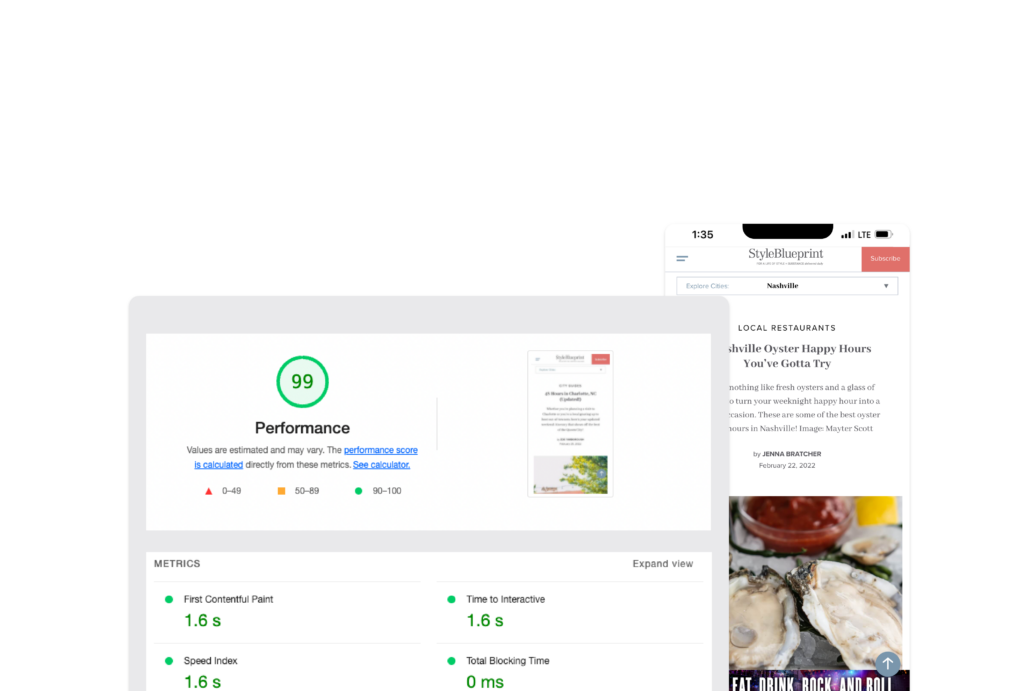
I delivered a performance-focused transformation: Boosted Lighthouse scores from 12 to 97+, Increased Search Console Core Web Vitals coverage from 0 to nearly 100%, Increased pages per session from 1.24 to 3.7, Implemented continuous scroll, enhanced reading space, and reduced visual interruptions for a significantly better UX
Project Details
005
Google’s Major Update
In June 2021, Google rolled out the Core Web Vitals update, which put performance and UX at the forefront of SEO rankings. These new standards prioritize user-centric metrics:
- Largest Contentful Paint (LCP): Loading speed of key visual elements
- First Input Delay (FID): Time to interaction
- Cumulative Layout Shift (CLS): Layout stability during load
Websites are graded from 0–100. Higher scores signal better UX and boost SEO rankings. StyleBlueprint was scoring around 12, and had zero passing URLs in Google Search Console. That’s when I came in—with the goal of not only fixing the problem but future-proofing the platform.
Establishing a Gameplan
StyleBlueprint had been publishing since 2009, and the site reflected that history—an accumulation of plugins, outdated customizations, and inconsistent performance.
I broke the recovery process into three phases:
- Evaluate website health and identify pain points
- Debug and optimize key performance blockers
- Establish monitoring tools and patterns to prevent regressions
Phase 1: Evaluate Website Health
Using Google Search Console, PageSpeed Insights, and CrUX Dashboard, I diagnosed:
- 10MB+ average page weight
- Over 220 requests per page
- High CLS from unreserved ad/image space
- No pages passing CWV metrics
- Slow load times and poor interaction feedback
These tools let me pinpoint issues on high-priority pages and establish benchmarks.
Phase 2: Debug & Optimize
Using Lighthouse, Chrome DevTools, and New Relic, I drilled down into code execution, render paths, and asset loading patterns.
Key Fixes Implemented:
- Script Localization: Prevented unnecessary global JS from bloated plugins
- Lazy Loading & Deferral: Deferred non-critical scripts, optimized render path
- TinyPNG Integration: Bulk-optimized legacy images
- Amazon S3 Offloading: Offloaded media assets for faster CDN delivery
- DOM Simplification: Reduced layout shifts and visual instability
Phase 3: UX Enhancements
To combat lost sessions and improve reader flow, I delivered UX improvements that directly impacted retention and engagement.
- Continuous Scroll Plugin: Developed a custom plugin to dynamically load next-article content via internal links. This turned individual articles into immersive longform experiences.
📈 Result: Pages per session increased from 1.24 → 3.7 - Improved Reading Space: Enlarged fonts, reduced padding, minimized clutter
- Ad Disruption Reduction: Repositioned or removed obtrusive placements
- Stability Enhancements: Eliminated layout shifts that interrupted reading flow
Metrics Before & After
| Metric | Before | After |
|---|---|---|
| Performance Score | ~12 | 97+ |
| Largest Contentful Paint (LCP) | ~4.2s | 1.2s |
| First Input Delay (FID) | ~380ms | <50ms |
| Cumulative Layout Shift (CLS) | ~0.41 | 0.03 |
| Core Web Vitals Coverage | 0 pages | ~100% |
| Pages per Session | 1.24 | 3.7 |
| Avg. Page Size | ~12MB | 1.4MB |
| Total Requests | 222 | 27 |
Conclusion
Keep it simple with a quick overview of why it’s important to please Google, and the before and after StyleBlueprint metrics.
Ask a question here.